
The next advantage in AI-assisted development comes from making generated changes easier to understand, verify, and operate.
Picture a pull request arriving before your coffee cools. The feature looks complete. The code is tidy. There are even tests.
Then the reviewer asks three questions: What happens when the request times out? Can a retry create a duplicate transaction? Who owns this service when it fails?
The implementation took minutes. Getting confident enough to ship it may take much longer.
That tension is a useful lens for this week’s technical conversation. AI can expand the supply of code. A team’s ability to absorb changes still depends on how well people understand and validate them.
Why this conversation is gaining attention
When I checked InfoQ’s trending list on October 10, 2026, it included stories about AI-generated code comprehension and spec-driven delivery. HackerNoon’s October 4 TechBeat also featured coding-agent architecture and instruction files. These are editorial and engagement signals from particular sites, rather than a ranking of the entire industry.
The underlying evidence deserves a closer look. In GitLab’s June 2026 AI Accountability Report announcement, a Harris Poll survey of 1,528 developers and technology buyers across six countries found that 78% reported faster code output. Meanwhile, 79% agreed that overall delivery had not accelerated at the same pace, and 85% agreed that the bottleneck had shifted toward review and validation.
Those are respondents’ assessments from vendor-sponsored research. They do not establish that AI caused slower delivery, or predict what will happen in every team. They do suggest a useful question: where does the time saved at the keyboard go?
When output outruns understanding
A reviewer doesn’t just check syntax. They reconstruct intent, compare the implementation with surrounding behavior, and look for failure modes the author missed.
If generated changes arrive faster than that work can happen, the queue grows. Large diffs make the problem harder: a plausible implementation can conceal a mistaken assumption across dozens of files.
Consider a hypothetical invoice-export feature. An agent implements an endpoint, uploads a file, and marks the export complete. The happy-path test passes. But if the upload succeeds and the status update fails, a retry may create another file. The important requirement was hiding between the steps.
Writing “add invoice export” leaves that behavior open. Writing “retries must reuse the same export identifier, and failed status updates must not create duplicate exports” gives the implementation and its reviewer something concrete to prove.
The workflow around the model matters
Akka’s September 2026 porting experiment offers a useful example. Despite the headline about 65 projects, the methodology distinguishes an initial pass implementing slices of up to 10% across 65 projects from full implementations of 10 selected projects.
The team describes a loop of discovery, specification, implementation, benchmarking, and improvement, with tests and design audits as completion conditions. This is a vendor-run experiment with selected projects, so it is not a general productivity benchmark. Its practical lesson is that the surrounding workflow deserves as much attention as the model.
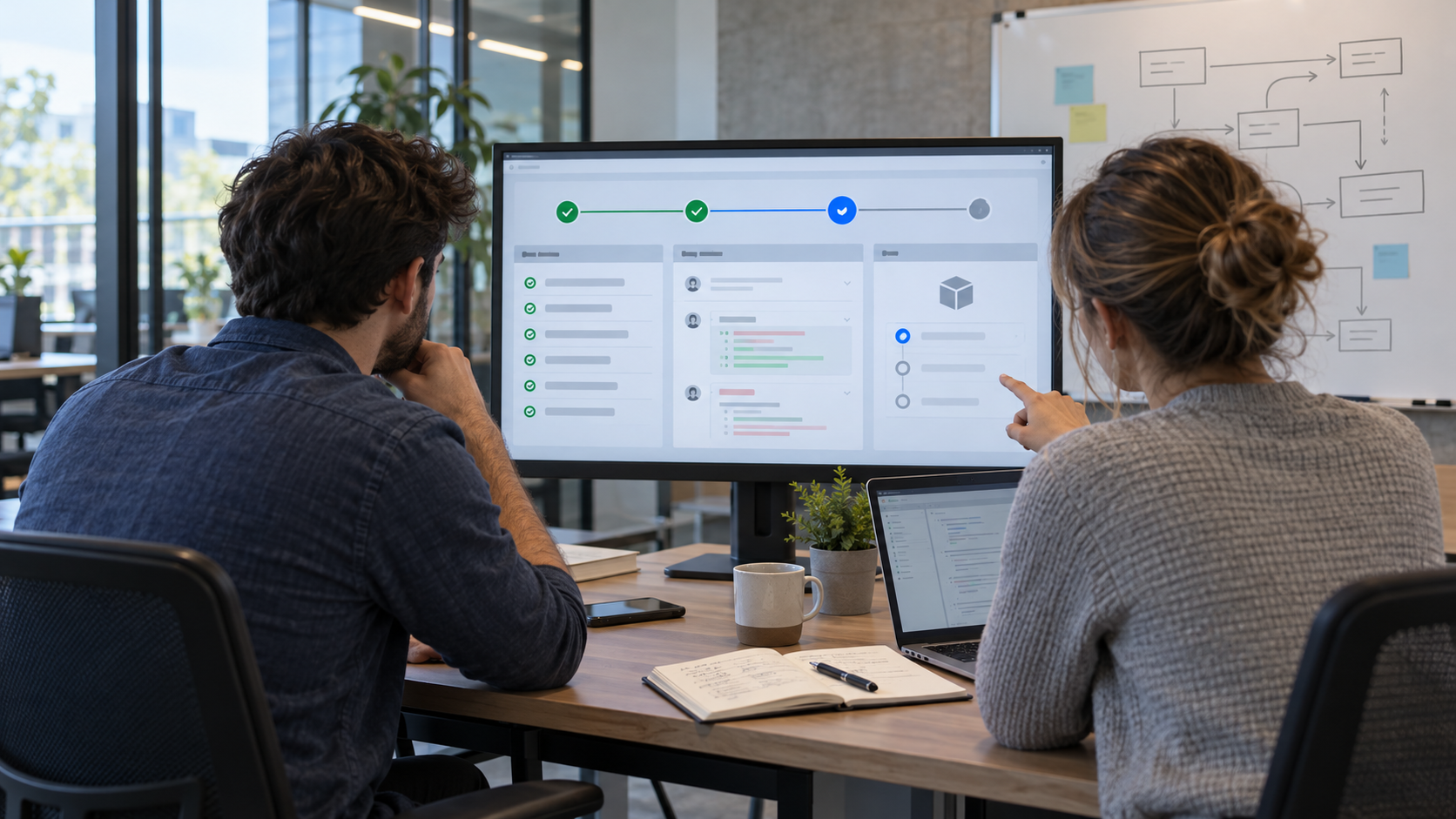
A practical workflow for your next AI-assisted change
- Define observable behavior. State the user outcome, the failure cases, and the constraints. For the export example, include retry behavior, access permissions, and what the user sees after a partial failure.
- Give the agent relevant context. Point it to the existing export code, API conventions, and the command that runs the relevant tests. Keep instructions focused enough that a reviewer can also understand them.
- Generate a small, complete change. Ask for one coherent behavior that can be reviewed independently. Splitting a feature is useful only if each part has a clear contract.
- Verify the risky assumptions. Run meaningful checks. Exercise the retry after a partial failure, attempt access as an unauthorized user, and check that existing behavior still works. A test suite can pass while missing the requirement that matters most.
- Review with an explanation and evidence. Include why the approach fits, which assumptions it makes, and what was actually tested. Have a responsible engineer inspect the implementation and unresolved risks.
- Observe the result after release. Assign an owner, define signals for failure, and prepare a rollback or recovery path. A merged pull request is one milestone in delivery.
Try measuring the whole journey
For a small pilot, choose a class of changes your team makes regularly. Record the time spent implementing, waiting for review, revising, and validating each one. Track escaped defects and reviewer effort alongside completion time.
Compare changes of similar scope, and be candid about differences in experience and complexity. A handful of tickets won’t prove a universal claim, but it can reveal whether your team’s constraint is implementation, review capacity, unclear requirements, or unreliable checks.
If implementation gets faster while review queues grow, try smaller changes and clearer acceptance criteria. If debugging grows, improve the evidence around failure cases. Let the observed problem guide the next investment.
The question to ask before you merge
AI-assisted development can be remarkably useful. Keeping that benefit requires a workflow that turns fast output into software people can maintain.
Before merging your next generated change, ask: Can someone explain why this works, show how it was checked, and take responsibility for it in production?
That is a stronger definition of progress than counting how quickly the code appeared.
Leave a Reply